The Center for Computational Biology develops new and innovative methods of examining data in the biological sciences whose scale and complexity have historically resisted analysis.
Featured News

Center for Computational Biology
A Tug-of-War Explains a Decades-Old Question About How Bacteria Swim
Read More
Bacteria tails rotate counterclockwise to propel the bacteria through liquid environments and clockwise to change direction. Previous research has suggested that the direction of the spin depends on a domino effect experienced by a ring of proteins in the bacterium’s tail. However, new research from Flatiron Institute scientists proposes that an energy-consuming, mechanical tug-of-war among these proteins is the deciding factor.
CCB’s mission is to develop modeling tools and theory for understanding biological processes and to create computational frameworks that will enable the analysis of the large, complex data sets being generated by new experimental technologies.
Research Areas

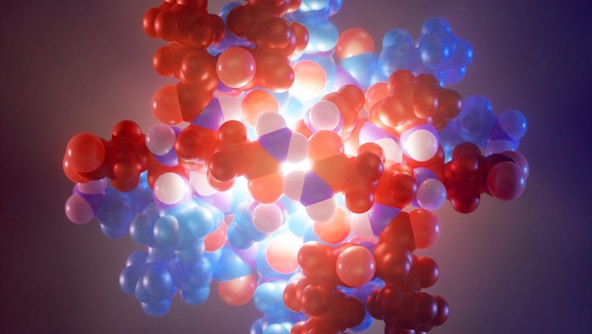
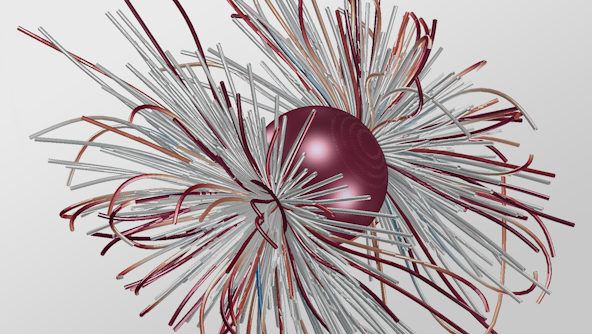

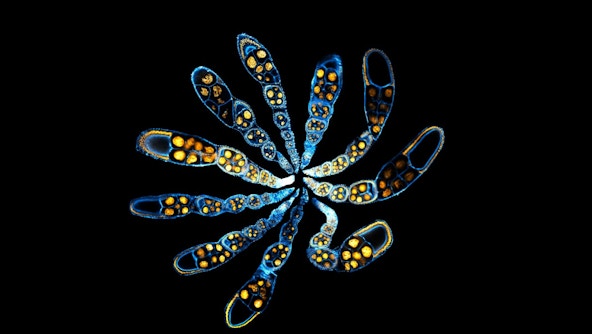

Collaborative Work
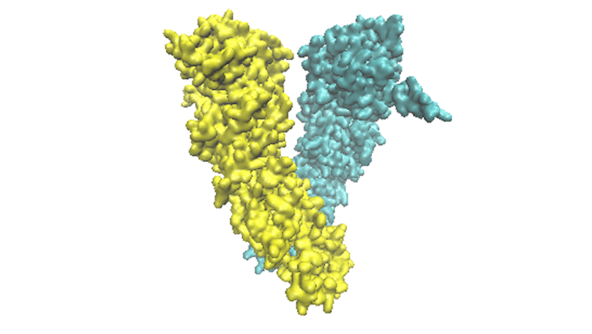
Structural and Molecular Biophysics
Underlying all biological processes are molecules and their interactions with each other. However, our ability to understand how these molecules function over biologically relevant scales remains very limited.
- CCB
- CCM

CCBx
The Center for Computational Biologyx (CCBx) is an effort by the Center for Computational Biology (CCB) to (a) create and validate quantitative techniques and (b) develop and test theories of biological systems that are predictive of these systems’ behaviors and responses to genetic, chemical and physical perturbations.
- CCB
Upcoming Events
-
16 Mon -
Meeting 10:30 a.m. - 12:00 p.m.
Developmental Dynamics Group Meeting
-
Meeting 10:30 a.m. - 12:00 p.m.
-
17 Tue -
Meeting 2:00 - 3:00 p.m.
COMPASS Meeting
-
Meeting 2:00 - 3:00 p.m.
-
18 Wed -
Meeting 12:00 - 1:00 p.m.
Computer Vision & Machine Learning Meeting
-
Meeting 12:00 - 1:00 p.m.
-
23 Mon -
Meeting 10:30 a.m. - 12:00 p.m.
Developmental Dynamics Group Meeting
-
Meeting 10:30 a.m. - 12:00 p.m.
-
24 Tue -
Meeting 10:00 - 11:00 a.m.
Biophysical Modeling Group Meeting
-
Meeting 12:00 - 2:00 p.m.
Genomics Group Meeting
-
Meeting 2:00 - 3:00 p.m.
COMPASS Meeting
-
Meeting 10:00 - 11:00 a.m.
-
25 Wed -
Meeting 12:00 - 1:00 p.m.
Computer Vision & Machine Learning Meeting
-
Meeting 12:00 - 1:00 p.m.
-
26 Thu -
Seminar 1:30 - 3:00 p.m.
Brown Bag Seminar
-
Seminar 1:30 - 3:00 p.m.
-
14 Tue
Publication Highlights
Age-related nigral downregulation of the Parkinson’s risk factor FAM49B primes human microglia for inflammaging
Jacqueline Martin, C. Park, O. Troyanskaya, et al.
Parkinson’s Disease (PD) is characterized by the loss of dopaminergic neurons in the substantia nigra pars compacta (SNpc), which is…
npj AgingThe Determinant Ratio Matrix Approach to Solving 3D Matching and 2D Orthographic Projection Alignment Tasks
Andrew J. Hanson, S. Hanson
Pose estimation is a general problem in computer vision with wide applications. The relative orientation of a 3D reference object…
arXiv:2511.195113D chromatin structures precede genome activation in Drosophila embryogenesis
Gabriel A. Dolsten, Evan Cofer, O. Troyanskaya, et al.
3D chromatin structure is critical for the regulation of gene expression during development. Here we used Micro-C assays at 100-bp…
Cell GenomicsDirector

Software

aLENS
This is the simulation tool for tracking assemblies of microtubules driven by motor proteins.
STKFMM
This is a numerical computation package for various single- and double-layer kernels for Laplace and Stokes operators in boundary integral methods, implemented on top of the highly-optimized kernel independent fast-multipole method package PVFMM.

humanbase
Data-driven predictions of gene expression, function, regulation, and interactions in human.

DeepSEA
Deep learning-based algorithmic framework for predicting chromatin effects

FNTM
Functional Networks of Tissues in Mouse
GIANT
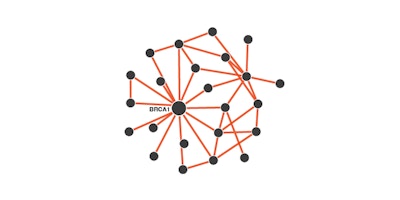
Genome-wide Scale functional interaction networks for 144 human tissues and cell types
IMP 2.0
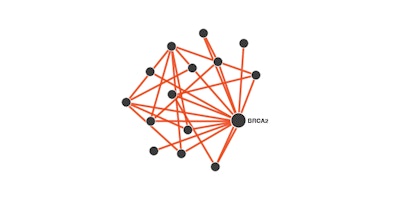
Integrative Multi-species Prediction

KNNimpute
K-Nearest Neighbors Imputation
Nano-Dissection
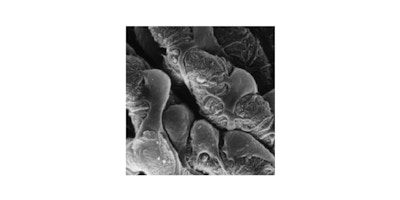
This server performs in silico nano-dissection, an approach we developed to identify genes with novel cell-lineage specific expression.

SEEK
Search-Based Exploration of Expression Compendium [Human]

SkellySim
SkellySim is a simulation package for simulating cellular components such as flexible filaments, motor proteins, and arbitrary rigid bodies.

Sleipnir
Sleipnir Library for Computational Functional Genomics

URSA(HD)
A data-driven perspective to your gene expression profile for human tissues and diseases.

Masala
The public repository for the Core library of the Masala software suite. Masala is a set of free and open-source tools for biomolecular modelling, with a plugin-based infrastructure that makes it easy to extend other software.